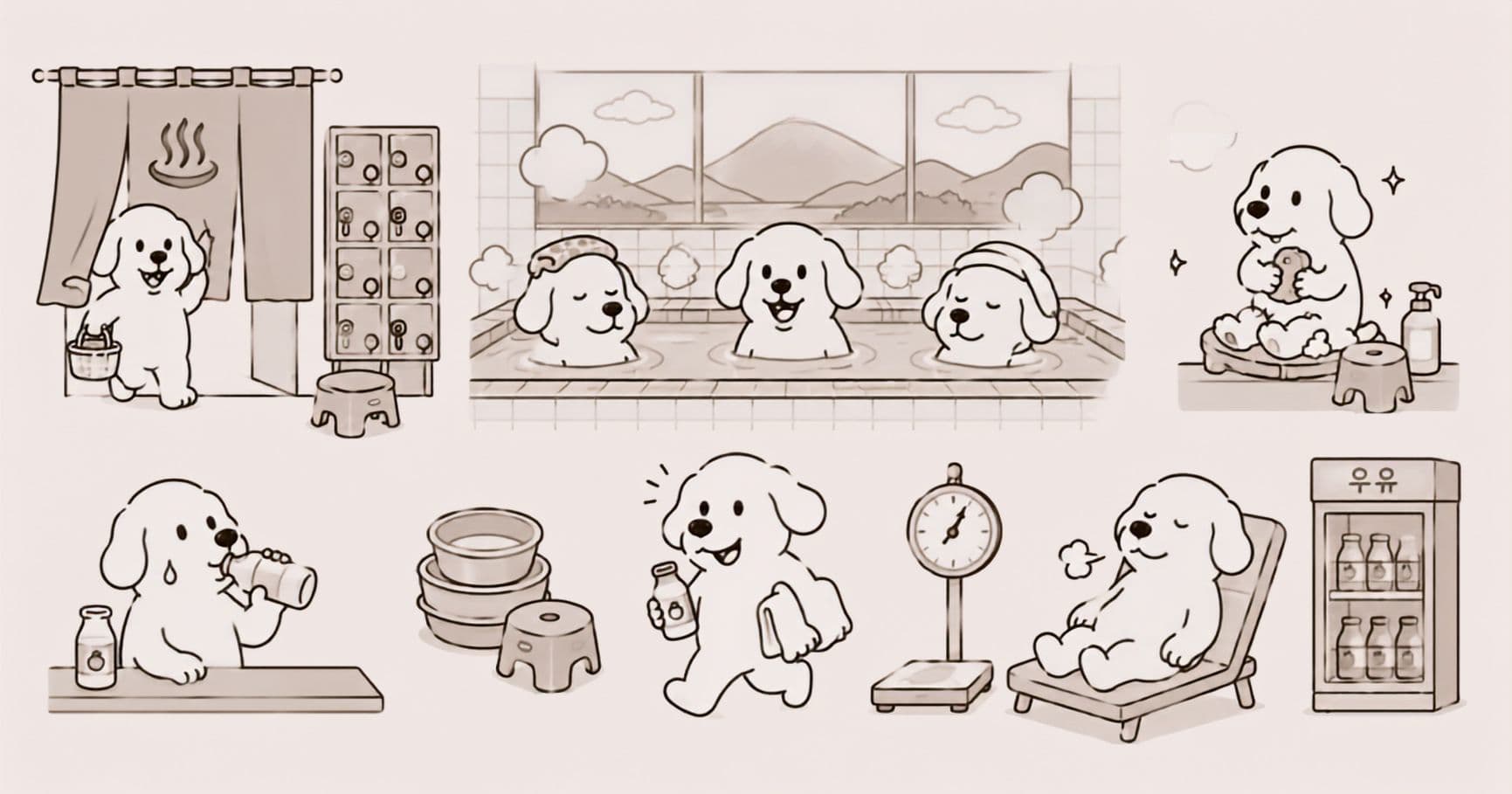
목욕탕 — The Unwritten Rules of Korean Public Bathhouses
목욕탕 is the Korean public bathhouse — older, more local, and more communal than a 찜질방. Here are the unwritten rules, the vocabulary, and what to expect inside.
Down a side street in an older Korean neighborhood, there's a building you might walk past without noticing.
A simple sign. Frosted glass. The smell of steam and soap.
Inside: basins, mirrors, hot pools, and a room full of people going about the serious business of getting clean.
This is 목욕탕. Not a spa. Not a tourist destination. Just a bathhouse — and a window into an older, quieter side of Korean daily life.
The word
목욕탕
Romanizationmogyoktang
Meaningpublic bathhouse
💡 목욕 (mogyok) means bathing. 탕 (tang) means hot water pool or hall. 목욕탕 is a neighborhood bathhouse — simpler and more local than a 찜질방. Gender-separated bathing areas, no mixed-gender zones. A neighborhood institution.
The vocabulary
때밀이
Romanizationttaemiri
Meaningscrub service / person who scrubs
💡 때 means dirt or dead skin. 밀다 means to push or scrub. 때밀이 is either the act of scrubbing or the person who does it. Getting a 때밀이 at a 목욕탕 is a deeply Korean experience — rough, effective, and surprisingly satisfying.
이태리 타올
RomanizationItalian ta-ol
Meaningexfoliating scrub mitt
💡 The rough cloth mitt used for 때밀이. Despite the name, this is entirely a Korean product. Sold everywhere. You can use it yourself or pay someone to do it for you. After a few minutes, rolls of dead skin visibly come off.
탕
Romanizationtang
Meaningsoaking pool
💡 The large communal pools inside a 목욕탕. 온탕 (warm), 열탕 (hot), 냉탕 (cold). You move between them, alternating temperatures. No swimwear — you enter the gender-separated area without clothing.
세신사
Romanizationseshinsa
Meaningprofessional body scrubber / scrub attendant
💡 세신 means body scrubbing. 세신사 is the professional who performs 때밀이 as a service. A trained skill — they know exactly how much pressure to use and work the whole body systematically. Very satisfying if you've never tried it.
목욕 가방
Romanizationmogyok gabang
Meaningbathhouse bag / toiletry bag
💡 Koreans bring their own soap, shampoo, conditioner, and skin care to the 목욕탕. A small bag for all of these is a bathhouse essential. Some 목욕탕 provide basic supplies, but regulars bring their own.
The unwritten rules
목욕탕 first visit
A first-time visitor with a Korean friend
A
A
목욕탕 처음인데, 어떻게 해야 해요?
This is my first time at a bathhouse — what do I do?
B
B
일단 신발 넣고 락커 받아요. 옷은 탈의실에서 다 벗어요.
First, put your shoes in a locker and get a key. You take everything off in the changing room.
A
A
수영복은요?
What about a swimsuit?
B
B
목욕탕에서는 수영복 안 입어요. 다 벗고 들어가야 해요.
You don't wear a swimsuit at a bathhouse. You go in without clothes.
A
A
때밀이도 받을 수 있어요?
Can I get a scrub too?
B
B
네, 세신사한테 따로 신청하면 돼요. 진짜 개운해요.
Yes, you can sign up with the scrub attendant separately. It's really refreshing.
The unwritten rules at a glance
RuleKoreanWhy it matters
No swimwear수영복 금지The gender-separated area is unclothed
Shower first탕 들어가기 전 샤워Always rinse before entering the pool
No photos사진 금지Privacy — always
Sit at a basin세면대Washing is done seated, not standing
Be quiet조용히목욕탕 is not a social event — it's quiet
Cultural note
목욕탕 is older and quieter than 찜질방. It's a neighborhood institution — regulars go every week, know the staff by name, see the same faces. The demographic skews older: grandmothers, retired men, people for whom the 목욕탕 has been part of their weekly life for decades.
For younger Koreans, 목욕탕 is sometimes a nostalgic memory — going with a parent as a child, being scrubbed by the 세신사 while sitting obediently on a plastic stool. That memory has a specific texture: the warm humid air, the sound of water, the smell of soap.
목욕탕 numbers are shrinking as apartments with private bathrooms became universal. But they haven't disappeared. In older neighborhoods, you'll still find them — the frosted glass, the simple sign, the steam coming from somewhere inside.