Modern Korea·Beginner·September 20, 2025·4 min read
네이버 vs 구글 — Why Koreans Don't Really Use Google
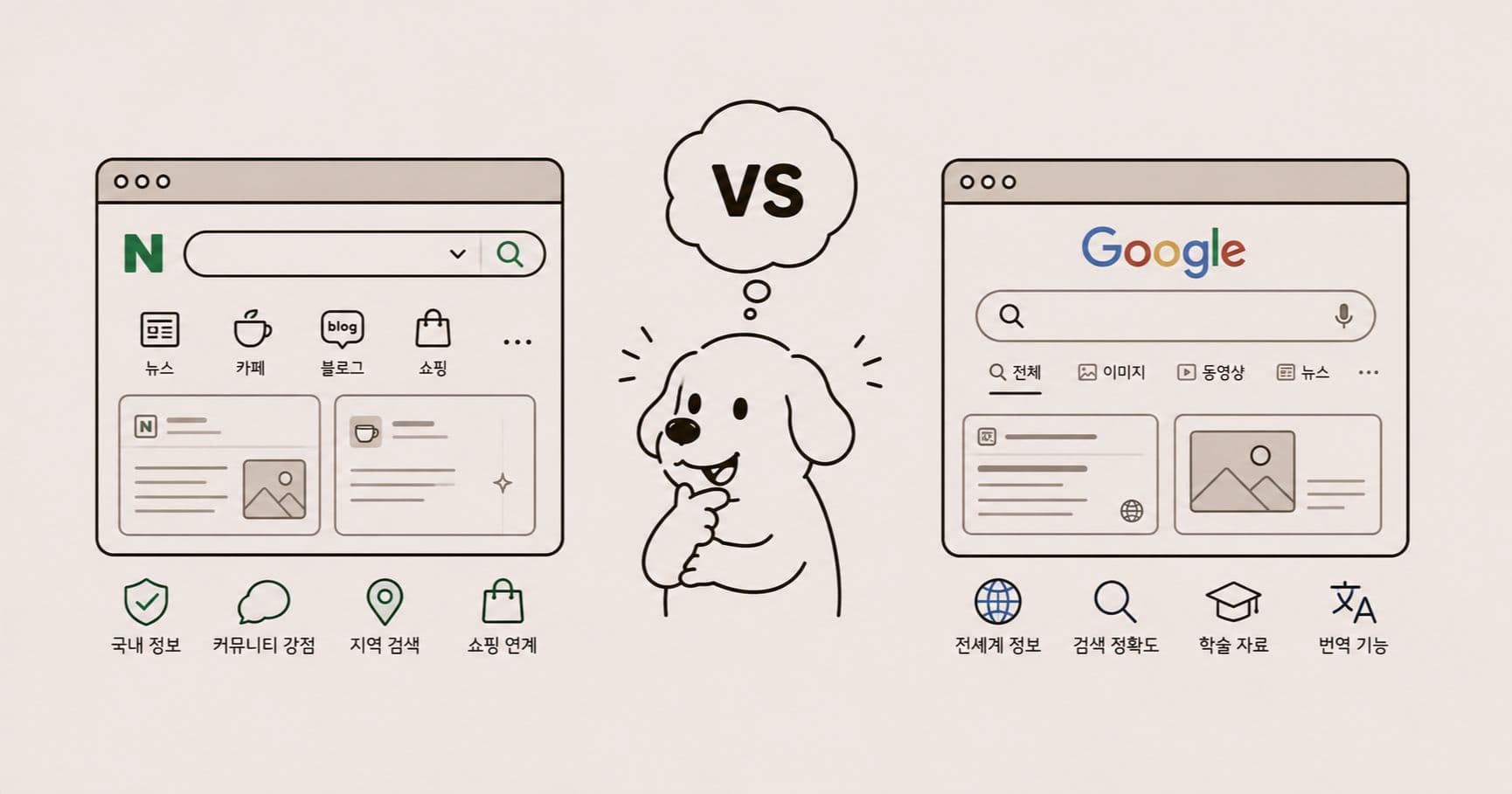
Google dominates the world. In Korea, Naver dominates Korea. Here's why Koreans search differently, what it means for daily life, and the vocabulary that comes with it.
You ask a Korean friend something like: "Just Google it."
They look at you slightly puzzled.
They already searched. On Naver.
Korea is one of the few countries where Google is not the default search engine. Naver — a Korean platform built in 1999 — still leads in search, news, shopping, maps, and community. Understanding why tells you something important about how Korea built its internet.
The word
네이버
Romanizationneibeo
MeaningNaver — Korea's dominant search and internet portal
💡 Launched in 1999. Not just a search engine — Naver is a portal with news, blogs, cafes (community forums), shopping, maps, webtoons, and more. 네이버에서 검색해봐 (Search on Naver) is the Korean equivalent of 'Google it.'
The vocabulary
검색하다
Romanizationgeomsaekhada
Meaningto search (online)
💡 검색 = search. 검색하다 = to search. 네이버에서 검색했어요 = I searched on Naver. 구글에서 검색했어요 = I searched on Google. Both are used, but for Korean-language content, Naver often returns more relevant results.
네이버 카페
Romanizationneibeo kape
MeaningNaver Cafe — online community forum
💡 Not a coffee shop. 네이버 카페 is an online community platform — think Facebook groups, but predating Facebook. Korean hobbyist communities, fan clubs, parent groups, and local communities have run on 네이버 카페 for decades.
네이버 블로그
Romanizationneibeo beulogeu
MeaningNaver Blog
💡 A blogging platform embedded in Naver. Korean restaurant reviews, travel logs, product reviews, and how-to guides often live on 네이버 블로그 — not on separate websites. For local Korean content, a Naver blog post often ranks above international results.
지식iN
Romanizationjisikin
MeaningNaver Knowledge iN — Q&A platform
💡 Naver's crowdsourced Q&A service. Like Yahoo Answers, but still actively used in Korea. People ask questions, community members answer, and the best answers accumulate. A massive archive of Korean life knowledge going back decades.
카카오맵
Romanizationkakaomep
MeaningKakaoMap — Korean maps app
💡 While Google Maps exists, many Koreans use KakaoMap or Naver Map for navigation. These apps have more accurate Korean address data, Korean business hours, and integrate with Korean transit systems better than Google Maps.
Searching in Korea
Searching for a restaurant
Two people deciding where to eat, looking it up
A
A
이 근처 맛집 어디 있는지 알아볼게요.
Let me look up good restaurants near here.
B
B
구글 말고 네이버에서 찾아봐요. 한국 식당 후기는 네이버 블로그가 더 많아요.
Don't use Google — search on Naver. There are more Korean restaurant reviews on Naver blogs.
A
A
아, 맞다. 지식iN에도 물어볼 수 있겠다.
Oh right. I could also ask on Knowledge iN.
B
B
그냥 '강남 파스타 맛집'으로 검색해봐요. 블로그 후기 많이 나와요.
Just search 'Gangnam pasta restaurant recommendation.' Lots of blog reviews will come up.
Naver vs Google in Korea
FeatureNaver 네이버Google 구글
Korean contentVery strongLess comprehensive
Restaurant reviews네이버 블로그Google Maps reviews
Community네이버 카페Reddit / Facebook groups
Navigation네이버맵 / 카카오맵Google Maps
English contentLimitedMuch better
Cultural note
Naver won in Korea partly because it was built for Korea from the start. Korean addresses are complex. Korean content was largely absent from early Google results. Naver filled the gap with a portal that felt complete — news, community, search, shopping, all in one place.
The result is a different internet experience. Korean digital culture is shaped by platforms built domestically: Naver for search, KakaoTalk for messaging, Kakao for payments and mobility, Coupang for e-commerce. Foreign platforms exist and are used — but the core of Korean digital daily life runs on Korean infrastructure.
For anyone spending time in Korea: download Naver, KakaoMap, and KakaoTalk. They're not alternatives to more familiar apps. They're the standard.