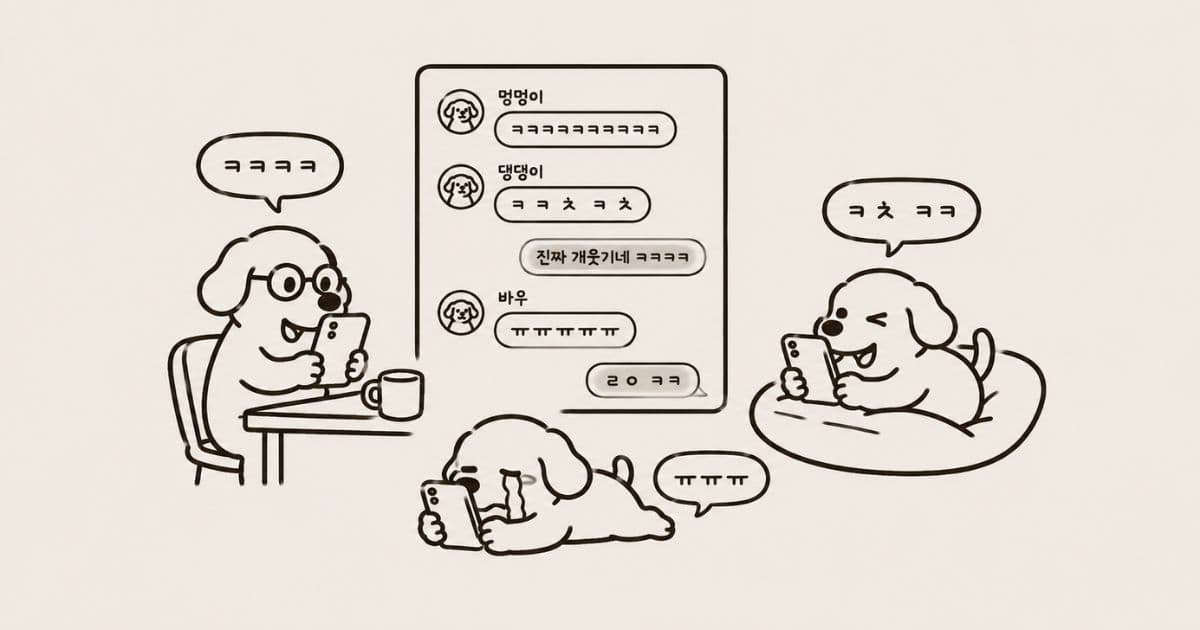
ㅋㅋ, ㄱㅊ, ㅠㅠ — the shortcuts Koreans use every day in texts and group chats that no textbook will ever teach you.
Open any Korean's KakaoTalk and you'll see messages that look like they're broken — ㅋㅋ, ㄱㅊ, ㅠㅠ. Random consonants firing back and forth, no vowels, no full words.
These aren't typos. They're a system.
Korean is written with Hangul, an alphabet where each syllable block is built from consonants and vowels. When Koreans text casually, they drop the vowels entirely and just send the consonants. It's faster to type, faster to read, and completely natural to anyone who grew up chatting on KakaoTalk.
If you've ever tried to read a Korean group chat and felt completely lost — this is probably why.
The laugh
ㅋㅋ
Romanizationkk
Meaninghaha / lol
💡 Short for 크크 (keu-keu), the Korean written laugh. The more ㅋ's, the funnier — ㅋㅋㅋㅋㅋ means you're actually losing it. One ㅋ alone can read as sarcastic.
ㅎㅎ
Romanizationhh
Meaninghehe
💡 Softer and warmer than ㅋㅋ. Used to be friendly, lighten the mood, or acknowledge something without fully committing to a laugh.
The emotions
ㅠㅠ
Romanizationuu
MeaningI'm crying / so sad
💡 The strokes look like tears streaming down. ㅜㅜ means exactly the same thing — both are the Korean 'crying face' in text. You'll see them constantly.
헐
Romanizationheol
Meaningoh wow / seriously?
💡 A full word, not a consonant shorthand. Used when something is shocking, unbelievable, or just a bit much. Close to 'wait, what?' or 'no way'. Essential reaction word.
ㄷㄷ
Romanizationdeudeul
Meaningshaking / that's wild
💡 Short for 덜덜덜, the sound of shaking. Used to express shock, fear, or serious impression. Send this when someone says something that leaves you speechless.
ㅇㅋ
Romanizationokei
MeaningOK / got it / sure
💡 Short for 오케이. A casual, quick agreement. More relaxed than ㅇㅇ — you're not just acknowledging, you're actively saying you're fine with it.
The quick replies
ㅇㅇ
Romanizationung-ung
Meaningyeah / yep
💡 Short for 응응. The most casual yes in Korean texting. Completely standard in KakaoTalk — formal 네 would feel bizarre in a chat with friends.
ㄴㄴ
Romanizationno-no
Meaningnope / no way
💡 Short for 노노. A quick, casual decline. Not rude — just efficient. Pair with ㅠㅠ if you actually feel bad about saying no.
ㅁㄹ
Romanizationmoreugetda
Meaningno idea / I dunno
💡 Short for 모르겠다. A shrug in text form. Used when you genuinely don't know, or when you can't be bothered to think about it.
ㅇㅋ
Romanizationokei
MeaningOK / got it / sure
💡 Short for 오케이. A casual, quick agreement. More relaxed than ㅇㅇ — you're not just acknowledging, you're actively saying you're fine with it.
The useful ones
ㄱㅊ
Romanizationgenchana
Meaningit's fine / no worries
💡 Short for 괜찮아. One of the most reassuring things you can say in a Korean chat. If someone apologises and you want to wave it off — ㄱㅊ does the job.
What a real conversation looks like
Late night KakaoTalk
Two friends making plans, 11pm
지우
지
내일 약속 어때?
How about plans tomorrow?
민준
민
ㅁㄹ 아직 생각 안 해봤어.
No idea, haven't thought about it yet
지우
지
ㅠㅠ 나는 영화 보고 싶었는데...
I was hoping to see a movie...
민준
민
ㅋㅋㅋ ㄱㅊ 나도 좋아
haha, sure, I'm down too
지우
지
헐 진짜? 완전 좋아!!!
Seriously? I'm so happy!!!
민준
민
ㅇㅇ 몇 시?
Yeah, what time?
지우
지
2시 어때?
How about 2?
민준
민
ㅇㅋ
Works for me
Quick Reference
All the shortcuts, grouped by what they do:
CategoryKoreanMeaning
Laughingㅋㅋ / ㅎㅎhaha / hehe
Crying / sadㅠㅠ / ㅜㅜI'm crying / so sad
Agreementㅇㅇ / ㅇㅋyeah / okay
Refusalㄴㄴnope / no way
Shock헐 / ㄷㄷseriously? / that's wild
Reassuranceㄱㅊit's fine / no worries
Cluelessㅁㄹno idea / I dunno
Cultural note
KakaoTalk is effectively the operating system of Korean social life. Almost every Korean has it, and almost every conversation happens there — from close friends to coworkers to family group chats.
Because so much communication runs through one app, a shared texting shorthand developed naturally. These consonant abbreviations aren't slang invented by teenagers. They're used across generations, in all kinds of group chats, by people who just want to reply fast without pulling out a full keyboard.
Learning to read them won't just help you understand texts. It'll help you understand the rhythm of how Koreans actually communicate with each other — quick, expressive, and full of personality.