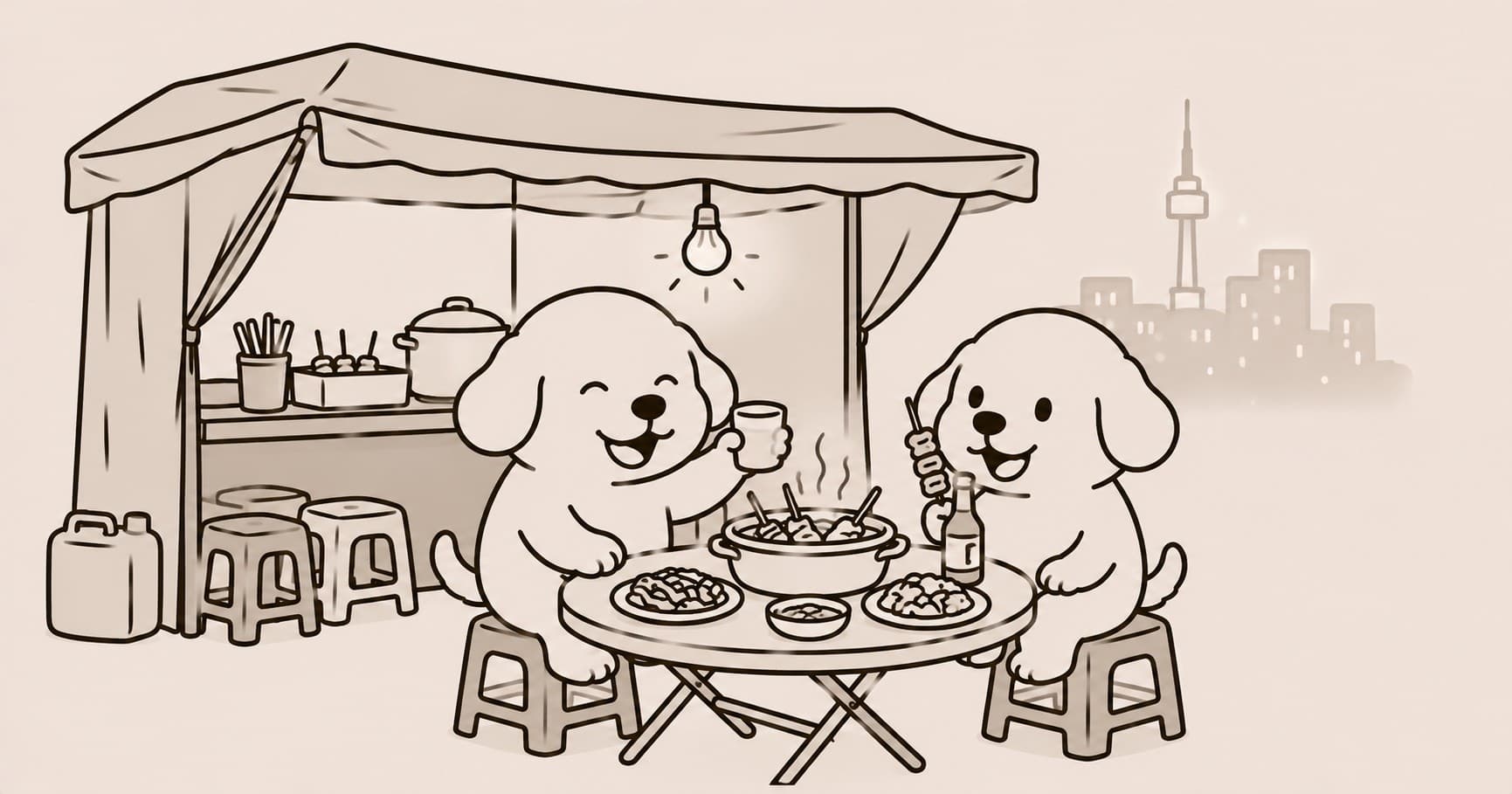
포장마차 are the small tented stalls that appear on Korean streets at night. Hot food, cheap soju, plastic stools, and strangers sitting close together. Here's the vocabulary to join in.
It's cold. It's late. You're walking home and you see orange light ahead.
A small tent on the sidewalk. Plastic stools around a low counter. Steam rising from pots. The smell of fish cakes and broth.
Someone behind the counter asks if you want to sit.
You sit.
This is 포장마차.
The word
포장마차
Romanizationpojangmacha
Meaningstreet food stall / covered cart
💡 포장 means covering or wrapping (the tarp roof). 마차 means cart or wagon. So 포장마차 is literally a 'covered cart' — a mobile street stall, usually open at night.
The vocabulary
오뎅
Romanizationodeng
Meaningfish cake skewers in broth
💡 The soul of 포장마차. Flat fish cakes on a skewer, simmered in a light broth. You eat the skewers and drink the broth from a small cup. Free refills of broth are standard.
어묵
Romanizationeomuk
Meaningfish cake (the formal word)
💡 오뎅 is the casual/slang word (from Japanese おでん). 어묵 is the standard Korean word for the same thing. Both are used — 오뎅 at the stall, 어묵 at the supermarket.
소주
Romanizationsoju
MeaningKorean rice liquor
💡 The drink of 포장마차. A small bottle costs around 4,000–5,000 won. Usually drunk in small glasses, poured for each other.
안주
Romanizationanju
Meaningfood eaten with drinks
💡 The word for food that goes with alcohol. At a 포장마차, the 안주 is the whole menu — tteokbokki, odeng, jeon, ramyeon. You don't drink without 안주.
아저씨 / 아주머니
Romanizationajeossi / ajumeoni
Meaningsir / ma'am (stall owner)
💡 How you address the person running the stall. 아저씨 for a man, 아주머니 for a woman. Slightly informal, but exactly right for this setting.
At the 포장마차
포장마차 at night
Two people stopping at a street stall after work
아주머니
아
어서 오세요! 앉아요, 앉아요.
Welcome! Sit down, sit down.
A
A
오뎅이랑 소주 한 병 주세요.
Fish cakes and one bottle of soju, please.
아주머니
아
떡볶이도 드실래요? 오늘 맛있어요.
Would you like tteokbokki too? It's good today.
B
B
주세요! 그리고 국물도 한 잔씩요.
Yes please! And a cup of the broth each too.
아주머니
아
잠깐만요, 금방 드릴게요.
Just a moment, I'll bring it right out.
What you'll find on the menu
FoodKoreanWhat it is
Fish cake skewers오뎅Hot broth, skewers, free refills
Spicy rice cakes떡볶이Sweet-spicy gochujang sauce
Savory pancake전Kimchi, seafood, or green onion
Ramyeon라면Instant noodles, cooked fresh
Blood sausage순대Korean rice-stuffed sausage
Cultural note
포장마차 culture is about more than the food. The stall creates a temporary community. Strangers sit elbow-to-elbow on plastic stools, sharing a counter, with the same small cups and the same hot broth in front of them.
There's something about cold weather and warm food under a tarp that makes people talk. Work complaints, relationship problems, big life decisions — conversations at 포장마차 go places that conversations in restaurants don't.
They're also disappearing slowly — city regulations have made it harder to run street stalls. But in many neighborhoods, especially near subway exits and along riversides, they're still there at night. Orange light, steam, and a spare stool.