Unit 7: Korean Pronunciation Rules, Why It Sounds Different From the Spelling
Why does 감사합니다 sound like 감사함니다? Learn the 4 basic Korean pronunciation rules (linking, nose sounds, tight sounds, and the shy ㅎ) and read 14 real words.
By the end of this lesson you will: know why Korean is sometimes said differently from how it's spelled, spot the four basic sound changes, and read 14 real words.
At the end of Unit 06, I showed you the word for "school": 학교. And I said it sounds a little different from how it's spelled.
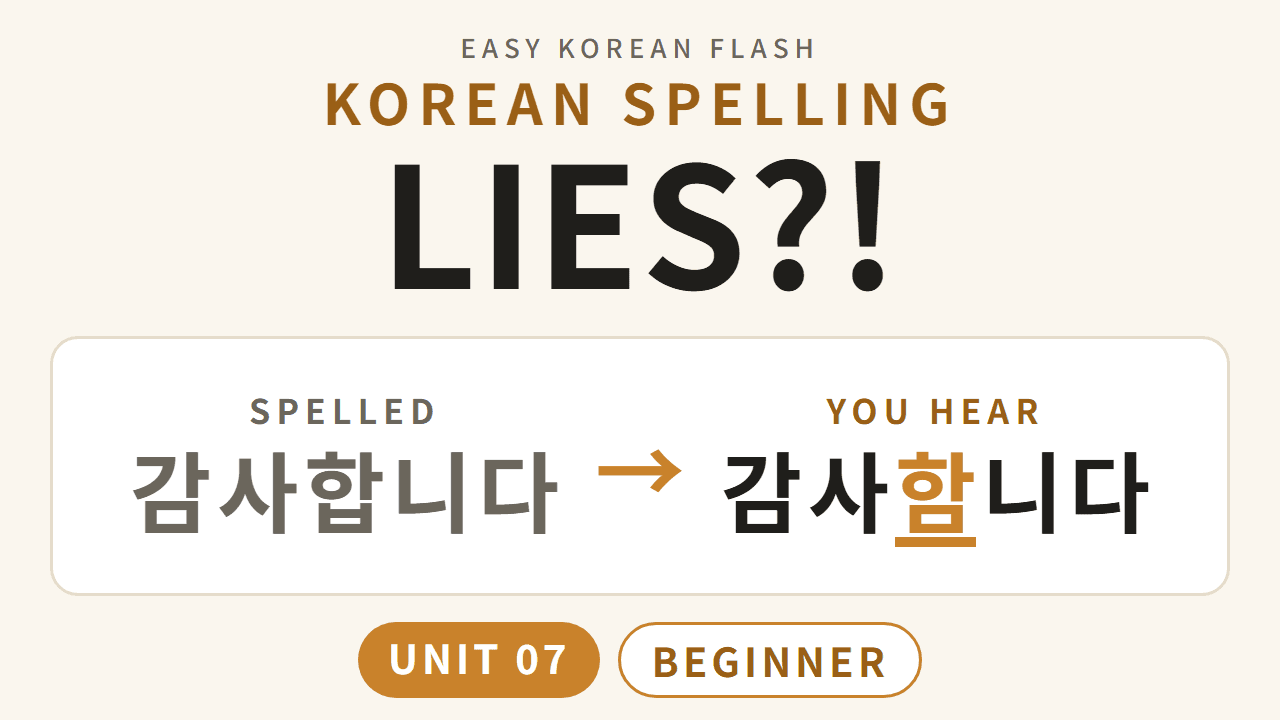
Here's another one. "Thank you" in Korean is 감사합니다. But it sounds like 감사함니다.
The spelling says one thing. The ears hear another. Don't worry, it's not random. Korean has a few simple pronunciation rules, and today you'll learn the four most useful ones.
We spell it one way. We say it a little differently. The spelling never changes.
You read the spelling. Your mouth makes the small changes naturally.
🎧 This post goes with the Unit 07 video. The brackets like [바름] show roughly how a word sounds. They're a teaching aid, not how Korean is written. Listen to the Korean audio in the video and repeat.
Mission 1: linking (the hopping letter)
Remember the silent ㅇ at the top of a block? It's an empty seat. Nothing sits there.
So what happens when a block with a bottom letter comes right before an empty seat? The bottom letter hops over and sits down.
| Spelling | Sounds like | Meaning |
|---|---|---|
| 발음 | [바름] | pronunciation |
| 음악 | [으막] | music |
| 한국어 | [한구거] | the Korean language |
| 단어 | [다너] | word |
One exception to watch: when the bottom letter is the "ng" sound (ㅇ), it stays where it is. 영어 (English) sounds just like it's spelled.
Bottom letter + silent ㅇ block → the letter hops up.
Mission 2: nose sounds (the nose switch)
Remember the stop sounds from Unit 06? Each stop had a partner at the same spot in the mouth that keeps going.
| Spot | Stop | Partner (keeps going) |
|---|---|---|
| Back of the tongue | ㄱ | ㅇ |
| Tongue tip | ㄷ | ㄴ |
| Lips | ㅂ | ㅁ |
Here's the rule. When a stop ending meets a nose sound (ㄴ or ㅁ), the stop puts on its partner. The mouth stays in the same spot. It just keeps humming through the nose.
| Spelling | Sounds like | Meaning |
|---|---|---|
| 국물 | [궁물] | broth |
| 한국말 | [한궁말] | the Korean language (spoken) |
| 감사합니다 | [감사함니다] | thank you |
So that's the mystery from the start! In 감사합니다, a lip-closing stop (ㅂ) meets a nose sound (ㄴ), and it becomes its lip partner (ㅁ). Now you know why "thank you" sounds the way it does.
Stop + nose sound → the stop turns into its keeps-going partner.
Mission 3: tight sounds (the clench)
You met the tight letters in Unit 05. Here's where they show up in real words.
When a block ends with a stop sound and the next block starts with a plain sound, the next sound turns tight. A little clench.
| Spelling | Sounds like | Meaning |
|---|---|---|
| 학교 | [학꾜] | school |
| 식당 | [식땅] | restaurant |
| 약속 | [약쏙] | promise, appointment |
| 국밥 | [국빱] | rice soup (a popular Korean dish!) |
That's why 학교 sounded different back in Unit 06.
This happens after stop endings. It doesn't happen after every bottom letter, and it isn't in every single word. So treat it as a pattern to notice, not a law. And don't force the tight sound. Clench a little and it comes naturally.
Stop ending + plain sound → the next sound turns tight.
Mission 4: the shy ㅎ
In Unit 06, ㅎ joined the stop group when it sat at the bottom. But it's actually a shy letter, and sometimes it almost disappears.
| Spelling | Sounds like | Meaning |
|---|---|---|
| 좋아요 | [조아요] | good, I like it |
| 좋다 | [조타] | good |
- In 좋아요, the shy letter at the bottom fades, and the next block steps forward. On a Korean video, 좋아요 is the Like button!
- In 좋다, the shy letter joins the next sound and turns it into a puff sound (ㅌ from Unit 05).
Don't worry about the rules. Just notice: a ㅎ at the bottom is usually quiet.
The four rules at a glance
| Rule | When it happens | Example |
|---|---|---|
| LINK | bottom letter + silent ㅇ block | 발음 → [바름] |
| NOSE | stop ending + nose sound (ㄴ ㅁ) | 국물 → [궁물] |
| TIGHT | stop ending + plain sound | 학교 → [학꾜] |
| SOFT ㅎ | bottom ㅎ | 좋아요 → [조아요] |
You don't need to memorize this chart. These are patterns, not laws, and real Korean has a few more that we'll meet step by step. Native speakers don't think about these rules. They just say words smoothly. That's your goal, too: read the spelling, say it smoothly.
Spot it! Quick quiz
Use your eyes first, then check the answers.
- In which word does the bottom letter hop to the next block? A. 학교 B. 한국어 C. 국물
- In which word does a stop sound turn into a nose sound? A. 음악 B. 식당 C. 감사합니다
- In which word does the next sound turn tight? A. 약속 B. 영어 C. 발음
Answers
- B · 한국어 → [한구거]
- C · 감사합니다 → [감사함니다]
- A · 약속 → [약쏙]
The video also has a boss level: you hear a word and decide which rule changed it. Try it a few days from now and see how you do.
The real test: four new words
These four words were not in the video. Guess how each one sounds, and which rule is at work: 직업 · 먹어 · 입구 · 낙엽
Check your work
- 직업 → [지겁] · job · LINK
- 먹어 → [머거] · eat (a form) · LINK
- 입구 → [입꾸] · entrance · TIGHT
- 낙엽 → [나겹] · fallen leaf · LINK
먹어 is only a reading drill. The grammar comes later.
What to remember
- Korean is spelled one way and sometimes said another way. The spelling never changes.
- LINK: a bottom letter hops onto a silent ㅇ (발음 → 바름). The "ng" letter stays.
- NOSE: a stop ending before ㄴ or ㅁ turns into its partner (감사합니다 → 감사함니다).
- TIGHT: after a stop ending, the next sound can turn tight (학교 → 학꾜).
- SOFT ㅎ: a bottom ㅎ is usually quiet (좋아요 → 조아요).
- Don't memorize the rules. Hear the pattern.
Practice
Read the spelling, then say it smoothly, the way the video says it:
한국어 · 음악 · 영어 · 단어 · 한국말 · 감사합니다 · 식당 · 약속 · 국밥 · 좋다
For each word, ask: which rule changed it? Then check yourself with the Workbook below.
Next up: Unit 08, the last letters. You'll meet a few extra vowels and a bottom with two letters. Then you'll know every letter of Hangul, and you can start reading real Korean, like signs and menus.
Free Workbook
Practice what you learned
Printable PDF for “Unit 7: Korean Pronunciation Rules, Why It Sounds Different From the Spelling” — no sign-up needed.
Unit 7 of Korean From Zero · See all lessons →