Korean Double Consonants & Aspirated Sounds: Hear Plain, Puff and Tight
Can you hear the difference between 가, 카 and 까? Learn plain, puff and tight Korean sounds, meet the five twin letters, and read 9 real words.
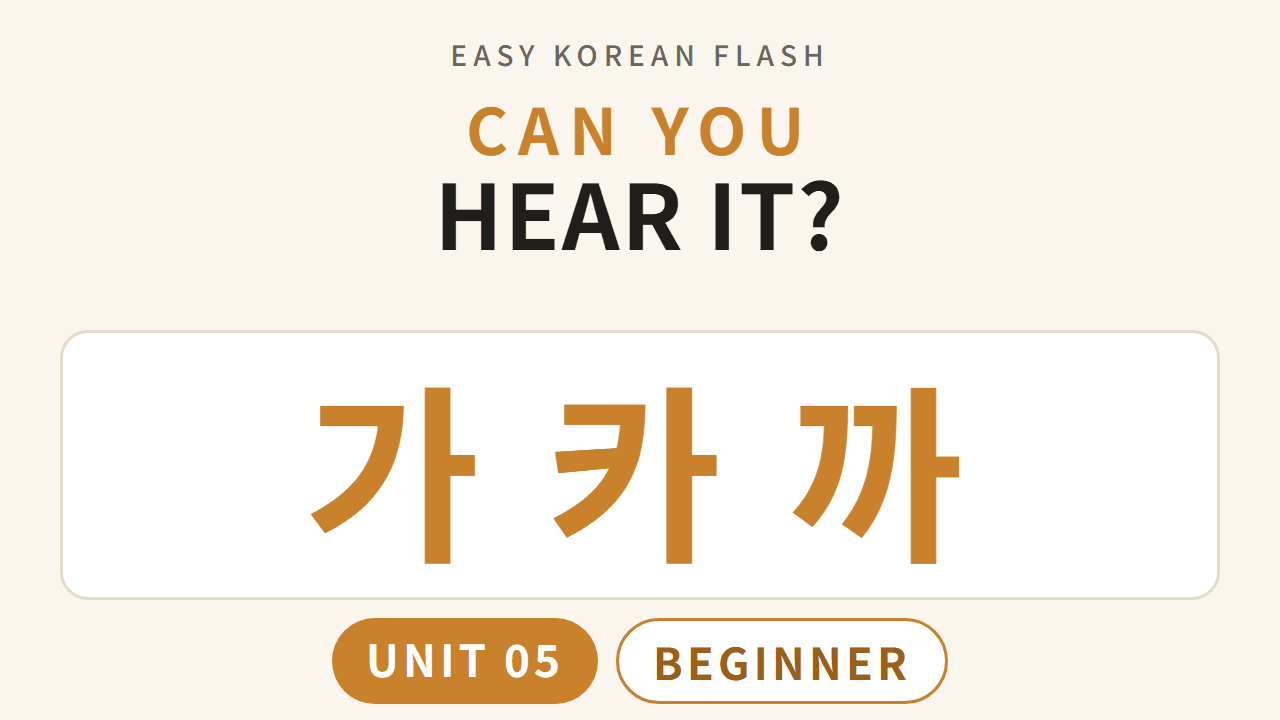
By the end of this lesson you will: tell plain, puff and tight sounds apart, know the five twin letters, chant the whole consonant chart, and read 9 real Korean words.
Listen to these three sounds: 가 · 카 · 까
Same? Different?
To English ears, they can sound almost the same. To a Korean ear, they're three different sounds. Today we train your ears, one short mission at a time.
🎧 This post goes with the Unit 05 video. The English comparisons are only guides, so listen to the Korean audio in the video and repeat. If the three sounds seem the same at first, that's totally normal.
The game board: plain, puff, tight
For each spot in the mouth, Korean has up to three sounds:
- Plain: a small, easy sound.
- Puff (aspirated): the same sound with a little extra air. You met these letters in Unit 02.
- Tight (tense): short and sharp, with no puff. These are the new twin letters.
| Plain | Puff | Tight |
|---|---|---|
| ㄱ | ㅋ | ㄲ |
| ㄷ | ㅌ | ㄸ |
| ㅂ | ㅍ | ㅃ |
| ㅈ | ㅊ | ㅉ |
Plain, puff, tight. Same spot in the mouth. Three different sounds.
Mission 1: the puff test
Grab a tissue and hold it in front of your mouth.
Say 가. The tissue moves a little. Now say 카. Big move! That's the puff.
Look at the letters too. The puff letter is the plain letter plus an extra stroke, and that stroke stands for the extra air.
| Plain | Puff | Blocks |
|---|---|---|
| ㄱ | ㅋ | 가 → 카 |
| ㄷ | ㅌ | 다 → 타 |
| ㅈ | ㅊ | 자 → 차 |
| ㅂ | ㅍ | 바 → 파 |
ㅂ and ㅍ look a little different, but they do the same job: ㅍ is the "more air" version of ㅂ.
The tissue is just a helper. Your best teacher is the Korean audio in the video.
Mission 2: the squeeze test
Now the opposite. These letters look like the same letter written twice. They're twins! In Korean, 쌍 means "twin."
| Twin | Name | Blocks |
|---|---|---|
| ㄲ | 쌍기역 | 가 → 까 |
| ㄸ | 쌍디귿 | 다 → 따 |
| ㅃ | 쌍비읍 | 바 → 빠 |
| ㅉ | 쌍지읒 | 자 → 짜 |
Say 까. Tight and sharp, and the tissue barely moves, much less than for 카.
Don't say it louder. Start the sound tighter.
One more twin: ㅆ
ㅅ + ㅅ = ㅆ (쌍시옷). Say 사, then 싸. The twin hisses a little longer and tighter.
ㅅ has no puff partner. It only has plain and tight.
That's five twins: ㄲ ㄸ ㅃ ㅆ ㅉ. Add the fourteen consonants you already know, and you now have all nineteen Korean consonants (14 + 5 = 19).
Mission 3: the chant
Read each row out loud, in order: plain, puff, tight. You don't need to memorize the chart. Come back and chant along anytime.
| Plain | Puff | Tight |
|---|---|---|
| 가 | 카 | 까 |
| 다 | 타 | 따 |
| 바 | 파 | 빠 |
| 자 | 차 | 짜 |
| 사 | — | 싸 |
Mission 4: one sound, two words
Why bother with the puff? Because one small sound can change the whole word.
| Plain | Puff |
|---|---|
| 비 (rain) | 피 (blood) |
| 자 (ruler) | 차 (car, tea) |
Swap the first letter ㅂ → ㅍ and the meaning flips from "rain" to "blood." One tiny sound. A different word.
Mission 5: the word hunt
Time to find puffs and twins inside real words. Use the same three steps from Unit 04: Split. Decode. Say it smoothly.
Hunt for the puff
| Word | Blocks | Meaning |
|---|---|---|
| 치마 | 치 + 마 | skirt |
| 포도 | 포 + 도 | grapes |
| 피아노 | 피 + 아 + 노 | piano |
Hunt for the twin
| Word | Blocks | Meaning |
|---|---|---|
| 아빠 | 아 + 빠 | dad |
| 꼬리 | 꼬 + 리 | tail |
| 뿌리 | 뿌 + 리 | root |
| 머리띠 | 머 + 리 + 띠 | hairband |
| 아저씨 | 아 + 저 + 씨 | a friendly word for a middle-aged man, like "mister" (see note) |
Careful with 아저씨: don't use it with someone you don't know.
Try the rapid-fire ones yourself first. Find the twin letter before you check the table: 꼬리 · 뿌리 · 머리띠 · 아저씨
Bonus: one word with both
| Word | Blocks | Meaning |
|---|---|---|
| 토끼 | 토 + 끼 | rabbit |
토끼 has ㅌ (puff) and ㄲ (tight) in one word.
That's nine real words. These are for reading practice, not memorizing. Look how much you can already read!
Spot it! Quick quiz
Use your eyes first, then check the answers.
- Which block has a twin letter? A. 짜 B. 차 C. 자
- Which block has the puff? A. 따 B. 빠 C. 파
- Which word has a twin letter? A. 치마 B. 뿌리 C. 포도
Answers
- A · 짜 has ㅉ
- C · 파 has ㅍ
- B · 뿌 has ㅃ
The real test: four new words
Here come four brand-new words that were not in the video. Decode each one into letters, then read it.
Try them before reading on: 코 · 파 · 까치 · 오빠
Check your work
- 코 = (ㅋ+ㅗ) → nose
- 파 = (ㅍ+ㅏ) → green onion
- 까치 = (ㄲ+ㅏ) + (ㅊ+ㅣ) → magpie
- 오빠 = (ㅇ+ㅗ) + (ㅃ+ㅏ) → older brother (woman speaking)
Listening takes time
Hearing plain, puff and tight is one of the hardest parts of Korean for English speakers. You don't need to get it perfect today. Listen again tomorrow, and the difference will get easier to hear.
The video also has a boss-level listening challenge, "Which one did you hear?" Try it a few days from now and see how you do.
What to remember
- Korean has three kinds of sounds for the same spot: plain, puff, tight.
- The puff letters have extra air: ㅋ ㅌ ㅍ ㅊ.
- The five twin letters are tight, with no puff: ㄲ ㄸ ㅃ ㅆ ㅉ. (쌍 = twin)
- One small sound can change a word: 비 / 피, 자 / 차.
- Korean has 19 consonants: 14 basic + 5 twins.
Practice
Chant each row of the chart out loud: plain, puff, tight. Then read the nine words, and come back tomorrow to read them again. The Unit 05 pages of the free Workbook below have tracing, a chart to complete, word reading and an answer key.
Next up: Unit 06, final consonants (받침). So far every block has had two parts, a consonant and a vowel. Next you'll meet the letter at the bottom of a block.
Free Workbook
Practice what you learned
Printable PDF for “Korean Double Consonants & Aspirated Sounds: Hear Plain, Puff and Tight” — no sign-up needed.
Unit 5 of Korean From Zero · See all lessons →