Unit 17: Essential Korean Phrases, 안녕하세요 · 감사합니다 · 죄송합니다 and 13 More
Learn 16 everyday Korean phrases for hello, goodbye, thanks, sorry, yes, no and excuse me, and pick the right one for each moment.
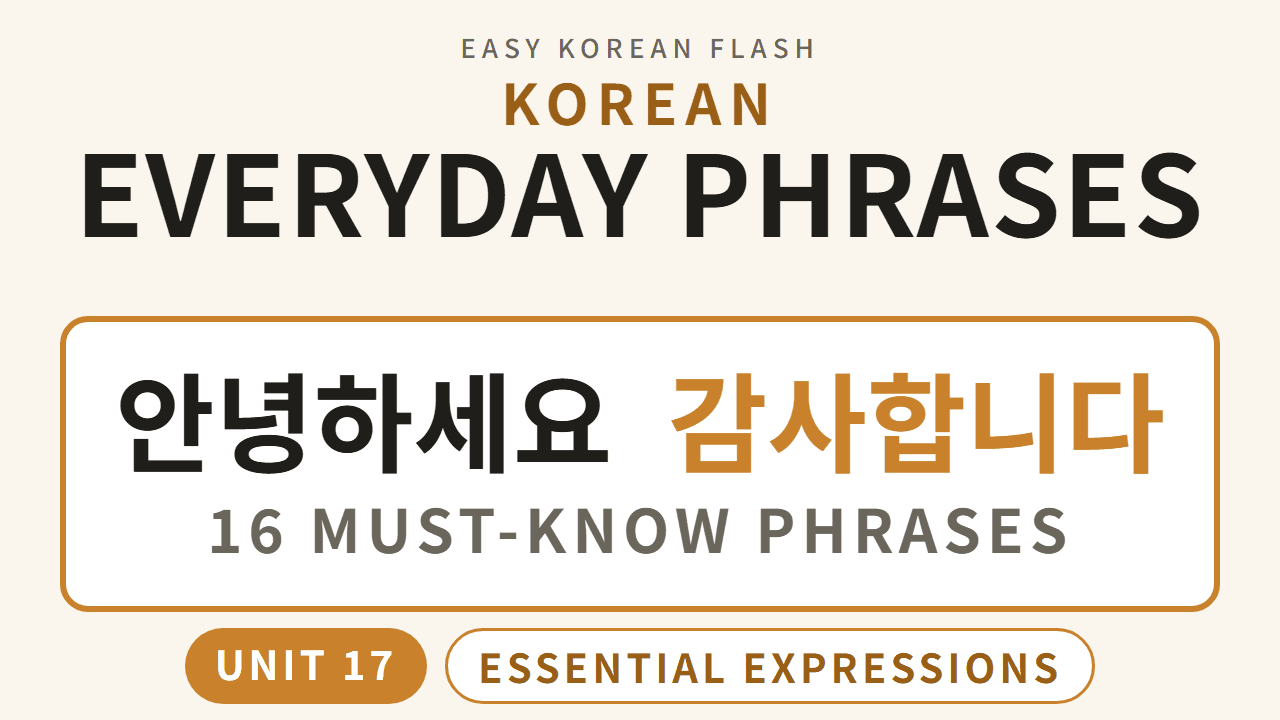
By the end of this lesson you will: use 16 everyday phrases, tell the two goodbyes apart, and pick the right phrase for each moment.
What are the first words you should say in Korea? 안녕하세요. 감사합니다. 죄송합니다. Hello. Thank you. I'm sorry.
Today you learn sixteen phrases you will use every single day. And there is a little puzzle: when you say goodbye, there are two ways, and which one you use depends on who is leaving.
🎧 This post goes with the Unit 17 video. Listen to the Korean audio there and repeat after the narrator.
The big idea: one phrase, the right moment
Learn each phrase as one whole piece. Do not take it apart. Just match it to the moment where you will use it.
One phrase, the right moment.
Mission 1: Hello & goodbye
| Korean | Meaning | |
|---|---|---|
| 👋 | 안녕하세요 | hello (any time of day, to almost anyone) |
| 🚪 | 안녕히 가세요 | goodbye, to the person who is leaving |
| 🏠 | 안녕히 계세요 | goodbye, to the person who is staying |
Look at the door:
- You stay, the other person leaves → 안녕히 가세요. ("Go safely.")
- You leave, the other person stays → 안녕히 계세요. ("Stay safely.")
Easy way to remember: the "go" phrase is for the person who goes. The "stay" phrase is for the person who stays.
Mission 2: Thanks & sorry
| Korean | Meaning | |
|---|---|---|
| 🙇 | 감사합니다 | thank you (polite and formal) |
| 😊 | 고마워요 | thanks (friendlier, more relaxed) |
| 🙏 | 죄송합니다 | I'm sorry (a formal, respectful apology) |
| 👌 | 괜찮아요 | it's okay, I'm fine |
감사합니다 and 고마워요 are both polite. One sounds formal, the other sounds friendly. Use the formal one when you want to be safe. Use the friendly one when things feel relaxed. 고마워요 ends with the same 요 you met in Unit 16.
괜찮아요 is a very handy answer when someone says sorry to you.
One phrase, the right moment.
Mission 3: Yes, no & excuse me
| Korean | Meaning | |
|---|---|---|
| ✅ | 네 | yes (also "I hear you" or "okay") |
| ❌ | 아니요 | no |
| 🙋 | 저기요 | excuse me (for a stranger, or someone across the room) |
| 🛎️ | 여기요 | excuse me, over here (to call a waiter) |
| 🤲 | 주세요 | please give me |
저기요 and 여기요 grew out of the words you met in Unit 13: over there and here. Both get someone's attention.
And 주세요 comes from Unit 15. Put it after something you want:
| Korean | Meaning |
|---|---|
| 물 주세요. | Water, please. |
Mission 4: Understand & react
| Korean | Meaning | |
|---|---|---|
| 💡 | 알아요 | I know, I understand |
| ❓ | 몰라요 | I don't know, I don't understand |
| 😋 | 맛있어요 | it's delicious |
| 👍 | 좋아요 | good, I like it |
몰라요 is super useful for a beginner. You can even use it with words you know: 한국어 몰라요. (I don't know Korean.) Don't worry, you are learning!
Mission 5: What do you say?
Cover the right column and say the phrase for each moment:
| The moment | Say |
|---|---|
| You walk into a shop. | 안녕하세요. |
| You leave a café, and the staff stays. | 안녕히 계세요. |
| A guest is leaving your home, and you stay. | 안녕히 가세요. |
| Someone helps you. | 감사합니다. |
| You bump into someone. | 죄송합니다. |
| You call out to a stranger. | 저기요. |
| You ask for water. | 물 주세요. |
| The food is great. | 맛있어요. |
You just used eight phrases the way real Koreans do! One phrase, the right moment.
Review the phrases
Tap a card to flip it.
Hello and goodbye:
← → Arrow keys to navigate · Space to flip
Thanks and sorry:
← → Arrow keys to navigate · Space to flip
Yes, no, excuse me:
← → Arrow keys to navigate · Space to flip
Understand and react:
← → Arrow keys to navigate · Space to flip
Quick quiz
- You are leaving, and the host stays. What do you say? A. 안녕히 계세요 B. 안녕히 가세요 C. 안녕하세요
- Which phrase is the friendly way to say "thanks"? A. 감사합니다 B. 고마워요 C. 죄송합니다
- You want to call the waiter. Which one? A. 괜찮아요 B. 몰라요 C. 여기요
Answers
- A · 안녕히 계세요
- B · 고마워요
- C · 여기요
Want more? Try the quizzes:
Quiz Yourself
Choose a mode to test your 4 words
Quiz Yourself
Choose a mode to test your 6 words
Quiz Yourself
Choose a mode to test your 5 words
The video also has a Boss Level: you hear one phrase first, with no text, and pick the meaning. Phrases take a few listens to stick, so try it again tomorrow.
What to remember
- One phrase, the right moment. Learn each phrase as one whole piece.
- 안녕히 가세요 is for the person who goes. 안녕히 계세요 is for the person who stays.
- 감사합니다 is formal and safe. 고마워요 is friendlier.
- 저기요 · 여기요 get someone's attention. 주세요 asks for something: 물 주세요.
- 알아요 · 몰라요 = I know · I don't know. 맛있어요 = delicious.
Practice
Read these out loud, with no English:
안녕하세요 · 안녕히 가세요 · 안녕히 계세요 · 감사합니다 · 고마워요 · 죄송합니다 · 괜찮아요 · 네
아니요 · 저기요 · 여기요 · 주세요 · 알아요 · 몰라요 · 맛있어요 · 좋아요
Which phrase? Write the Korean:
- You step out of a shop, and the clerk stays. = ?
- You call the waiter. = ?
- Someone says sorry to you. You say "it's okay." = ?
And four new phrases, not in the video. Just listen and copy them as whole pieces:
잘 먹겠습니다 (said before a meal) · 잘 먹었습니다 (said after a meal) · 어서 오세요 (Welcome! Staff say this when you enter) · 또 만나요 (See you again!)
Answers
- 안녕히 계세요. · 여기요. · 괜찮아요.
- Friendly (요) or formal (니다)? 감사합니다 = 니다 · 고마워요 = 요 · 죄송합니다 = 니다
Next up: Unit 18, how Korean sentences work. It is different from English, and it is simpler than you think.
Free Workbook
Practice what you learned
Printable PDF for “Unit 17: Essential Korean Phrases, 안녕하세요 · 감사합니다 · 죄송합니다 and 13 More” — no sign-up needed.
Unit 17 of Korean From Zero · See all lessons →