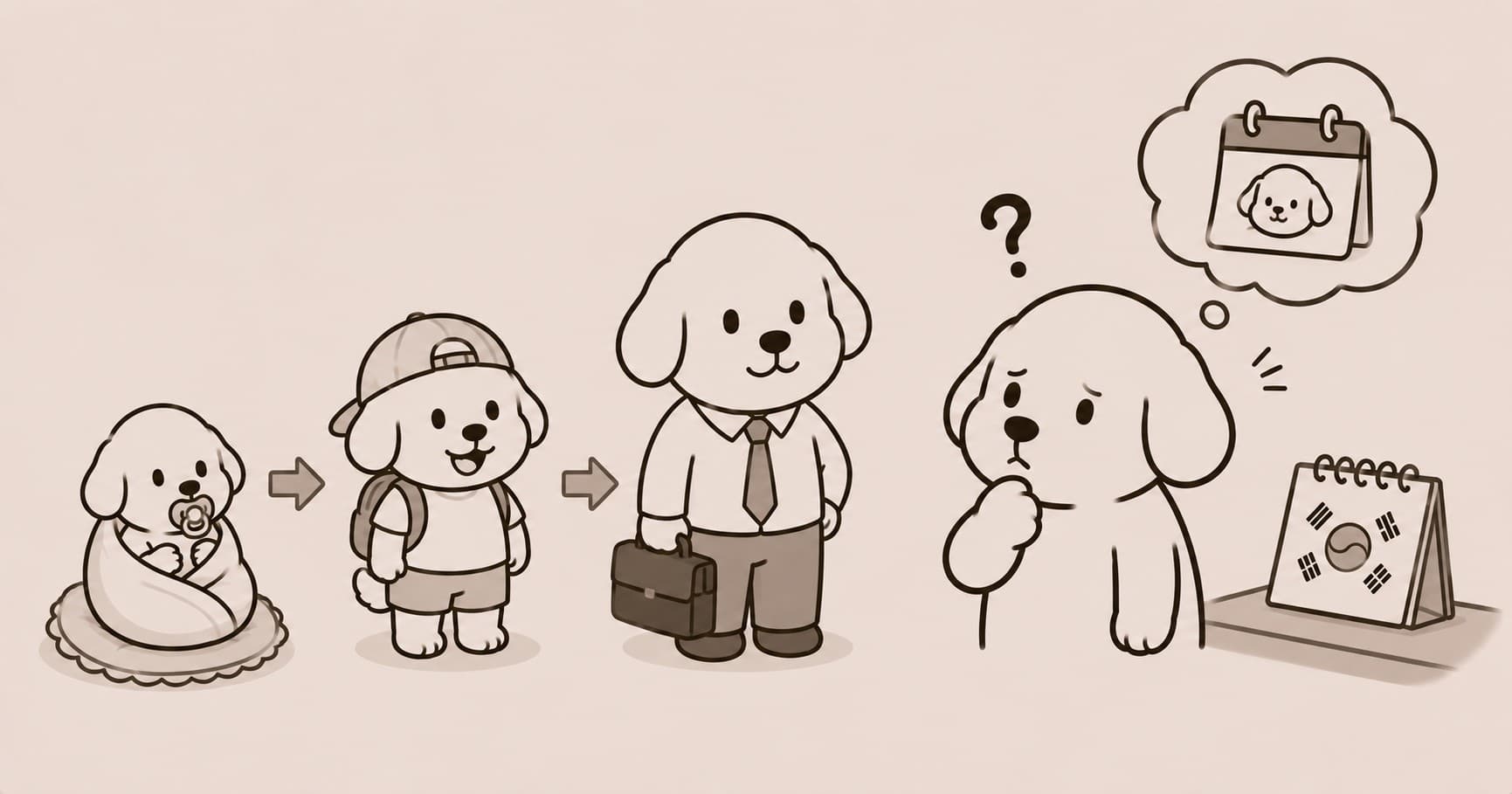
In Korea, you are older than you think. The Korean age system works differently from the international system — and understanding it explains why age comes up in every first conversation.
You meet someone in Korea for the first time.
Within two minutes, they ask: 나이가 어떻게 되세요?
How old are you?
In most countries, this question takes time to arrive — if it arrives at all. In Korea, it comes immediately. Before your name is fully exchanged.
Age in Korea is not just personal information. It's social infrastructure. It determines how you speak, what you call someone, and where you stand in every relationship.
The word
나이
Romanizationnai
Meaningage
💡 The standard word for age. 나이가 어떻게 되세요? = How old are you? (polite). 나이가 몇 살이에요? is slightly more direct. Both are completely normal to ask.
The two systems
한국 나이
Romanizationhanguk nai
MeaningKorean age
💡 The traditional system: you are 1 year old at birth, and everyone gains a year on January 1st — not on their birthday. So a baby born on December 31st is already 2 years old the next day. Korea officially moved toward international age in 2023, but Korean age is still deeply embedded in daily life.
만 나이
Romanizationman nai
Meaninginternational age / full age
💡 만 means 'full' or 'complete.' 만 나이 is the age counted from birth, gaining a year only on your birthday — the system used internationally. Since June 2023, Korea's legal standard shifted to 만 나이. In everyday conversation, both systems still circulate.
띠
Romanizationtii
Meaningzodiac year / birth year animal
💡 The 12-year zodiac cycle. Koreans often ask 띠가 뭐예요? (What's your zodiac year?) as a polite way to estimate age without asking directly. Saying 용띠예요 (I'm a dragon) immediately reveals your birth year.
Why age matters so much
동갑
Romanizationdonggap
Meaningsame age
💡 동갑이에요? = Are we the same age? A key social question. If two people are the same age (동갑), they can often immediately use 반말 (casual speech) with each other. Finding out you're 동갑 is a small social relief — it flattens the hierarchy.
연상 / 연하
Romanizationyeongsang / yeonha
Meaningolder / younger (in a relationship)
💡 연상 = older (by years). 연하 = younger. Used especially about romantic relationships. 연상연하 커플 = a couple with an age gap. 연상 남자친구 = older boyfriend.
Asking and answering
나이 in a first meeting
Two people meeting at a social gathering
A
A
혹시 나이가 어떻게 되세요? 실례가 아니라면요.
May I ask how old you are? If you don't mind.
B
B
저 96년생이에요. 한국 나이로 스물아홉이고요.
I was born in 1996. Twenty-nine in Korean age.
A
A
아, 저도 96년생이에요! 동갑이네요.
Oh, I was born in 1996 too! We're the same age.
B
B
진짜요? 그럼 말 편하게 해도 될 것 같은데요.
Really? Then I think we can speak casually with each other.
A
A
좋아요, 그렇게 하자!
Sounds good, let's do that!
Korean age vs international age
SystemKoreanHow it works
Korean age한국 나이Born = 1, +1 every New Year's Day
International age만 나이Born = 0, +1 on each birthday
Same age동갑Born in the same year — social equals
Birth year~년생96년생 = born in 1996
Zodiac animal띠Polite way to estimate age
Cultural note
Age in Korea structures everything — language, relationships, who pours the drinks, who walks through the door first. The question 나이가 어떻게 되세요? is not rudeness. It's a necessity: without knowing the age relationship, the conversation has no grammar.
Since 2023, Korea legally adopted 만 나이 for official purposes — medical records, legal documents, government services. But in daily social life, Korean age hasn't disappeared. People still say 저 스물아홉이에요 meaning Korean age, and the whole system of 선배/후배 (senior/junior), 형/언니/오빠/누나, and speech levels remains tied to birth year.
When someone asks your age in Korea, they are not being intrusive. They are trying to figure out how to treat you properly. It's a kind of care, even if it takes some getting used to.