The 14 Basic Korean Consonants (and How They Join Vowels)
Learn the 14 basic Korean consonants, their names and sounds, and how they join vowels to make syllables.
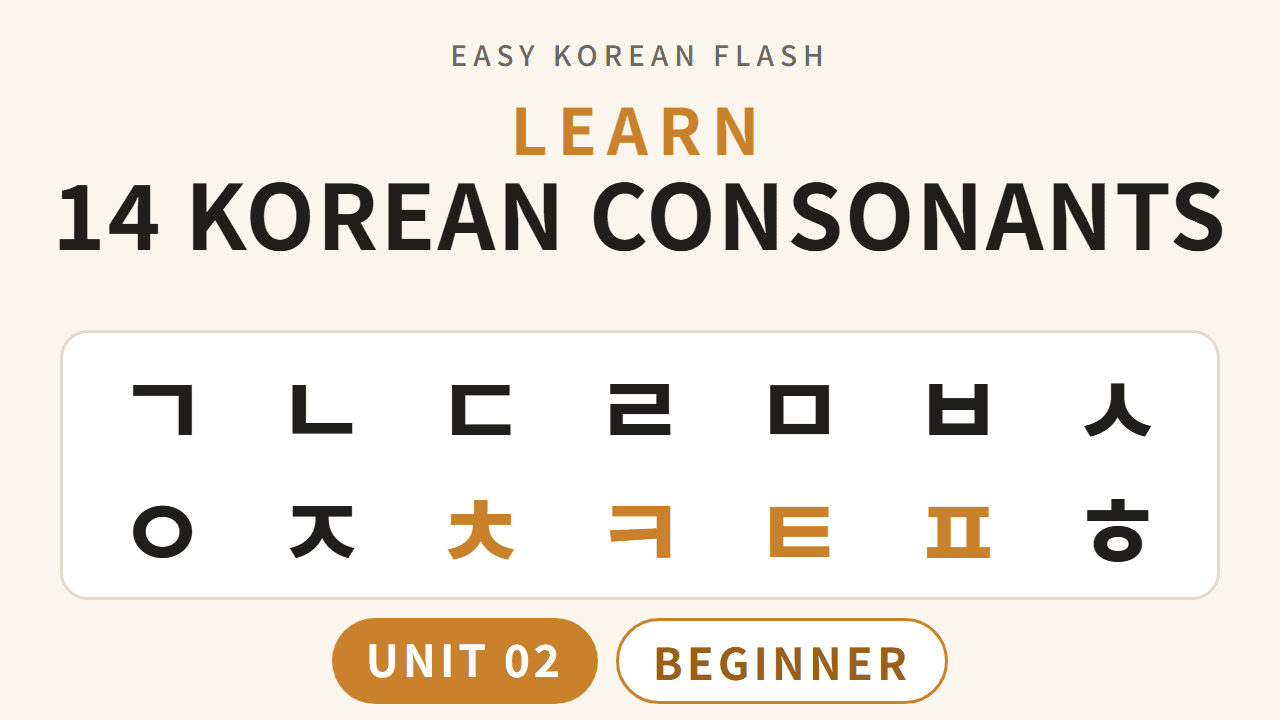
In Unit 01 you learned the ten basic vowels. Now it's time for the other important part of a Korean syllable: consonants. There are 14 basic consonants. In this post you'll learn their names, their basic sounds, and how they combine with vowels to make real syllables.
Don't try to memorize everything at once. Take it one group at a time.
🎧 This post follows the Unit 02 video. The English sounds below are only approximate guides. Korean consonants don't always match one English consonant exactly, so listen to the native-speaker audio and repeat.
How a consonant and a vowel work together
Look at this block: 가
It has two letters: ㄱ (a consonant) and ㅏ (a vowel).
ㄱ + ㅏ = 가
Here the vowel ㅏ sits on the right side of the consonant. You already know the vowel. The only new part is the consonant.
The 14 consonants
Each consonant has a name and a basic sound. Practice with the vowel ㅏ: that gives you a syllable to say.
Group A: ㄱ ㄴ ㄷ ㄹ
| Letter | Name | Basic sound | + ㅏ |
|---|---|---|---|
| ㄱ | 기역 | between "g" and "k," depending on position | 가 |
| ㄴ | 니은 | like English "n" | 나 |
| ㄷ | 디귿 | between "d" and "t," depending on position | 다 |
| ㄹ | 리을 | somewhat like "r" or "l," depending on position | 라 |
ㄹ can be tricky for English speakers. You don't need to master it today. First, just learn the shape.
Group B: ㅁ ㅂ ㅅ ㅇ
| Letter | Name | Basic sound | + ㅏ |
|---|---|---|---|
| ㅁ | 미음 | like English "m" | 마 |
| ㅂ | 비읍 | between "b" and "p," depending on position | 바 |
| ㅅ | 시옷 | like English "s" | 사 |
| ㅇ | 이응 | silent at the beginning | 아 |
💡 Memory trick: the shape of ㅁ looks like a mouth, which is a handy way to remember "m."
ㅇ is special. It has two roles. At the beginning of a syllable it is silent, which is why 아 sounds just like the vowel ㅏ. At the end of a syllable it sounds like "ng", but you'll learn that later. For now, remember one rule: ㅇ at the beginning is silent.
Group C: ㅈ ㅊ ㅋ ㅌ
| Letter | Name | Basic sound | + ㅏ |
|---|---|---|---|
| ㅈ | 지읒 | like a "j" sound | 자 |
| ㅊ | 치읓 | "ch," with more air | 차 |
| ㅋ | 키읔 | like ㄱ, with more air | 카 |
| ㅌ | 티읕 | like ㄷ, with more air | 타 |
Group D: ㅍ ㅎ
| Letter | Name | Basic sound | + ㅏ |
|---|---|---|---|
| ㅍ | 피읖 | like ㅂ, with more air | 파 |
| ㅎ | 히읗 | like English "h" | 하 |
A shape trick: "one more line = more air"
Some consonants are close relatives of others. Look at the extra stroke:
| Plain | + extra line | Difference |
|---|---|---|
| ㄱ | ㅋ | more air |
| ㄷ | ㅌ | more air |
| ㅈ | ㅊ | more air |
Try saying these pairs, and listen for the extra puff of air in the second one:
가 → 카 · 다 → 타 · 자 → 차 · 바 → 파
Build your first syllables
Keep the vowel ㅏ and change only the consonant:
가 · 나 · 다 · 라 · 마 · 바 · 사 · 아 자 · 차 · 카 · 타 · 파 · 하
The vowel stays the same. Only the consonant changes. This is how you start reading Korean.
Where does the vowel go?
- ㅏ and ㅣ go on the right side of the consonant: 가, 기
- ㅗ and ㅜ go below the consonant: 고, 구
Here is ㄱ with four different vowels: 가 · 고 · 구 · 기
And a quick pattern table to read aloud, one row at a time:
| 가 | 고 | 구 | 기 |
| 나 | 노 | 누 | 니 |
| 다 | 도 | 두 | 디 |
| 라 | 로 | 루 | 리 |
| 마 | 모 | 무 | 미 |
| 바 | 보 | 부 | 비 |
| 사 | 소 | 수 | 시 |
| 아 | 오 | 우 | 이 |
(In the last row, ㅇ is silent, so these sound just like the vowels.)
Try decoding
You don't need to memorize syllables. You need to be able to take them apart:
- 수 = ㅅ + ㅜ
- 두 = ㄷ + ㅜ
- 피 = ㅍ + ㅣ
- 호 = ㅎ + ㅗ
You're not just memorizing Korean. You're learning how to decode it.
Quick quiz
- Which consonant sounds similar to "n"? A. ㄱ B. ㅁ C. ㄴ
- Which consonant is silent at the beginning of a syllable? A. ㅅ B. ㅎ C. ㅇ
- What is the name of ㅂ? A. 비읍 B. 디귿 C. 시옷
- Which has more air, 가 or 카?
Answers
- C · ㄴ 2. C · ㅇ 3. A · 비읍 4. 카, because ㅋ has more air than ㄱ.
What to remember
- Korean has 14 basic consonants: ㄱ ㄴ ㄷ ㄹ ㅁ ㅂ ㅅ ㅇ ㅈ ㅊ ㅋ ㅌ ㅍ ㅎ.
- A consonant + a vowel makes a syllable block.
- ㅇ is silent at the beginning of a syllable.
- ㅋ, ㅌ, ㅊ, ㅍ have more air than ㄱ, ㄷ, ㅈ, ㅂ.
- The English sounds are only approximate. Listen and repeat.
Practice
Read the 14 consonants out loud, then combine each with ㅏ. The Unit 02 pages of the workbook (PDF) have naming, building and decoding exercises. Try to read without romanization. The more you see the letters, the faster you'll recognize them.
Next up: Unit 03 – how syllable blocks work, and exactly where each letter goes.
Free Workbook
Practice what you learned
Printable PDF for “The 14 Basic Korean Consonants (and How They Join Vowels)” — no sign-up needed.
Unit 2 of Korean From Zero · See all lessons →