Unit 10: Korean Family Words, 엄마, 아빠, 오빠, 형 Explained
Your first 16 Korean words: mom, dad, grandparents, friends and the older brother puzzle (형 vs 오빠). Everyday vs formal, and casual vs polite “I”.
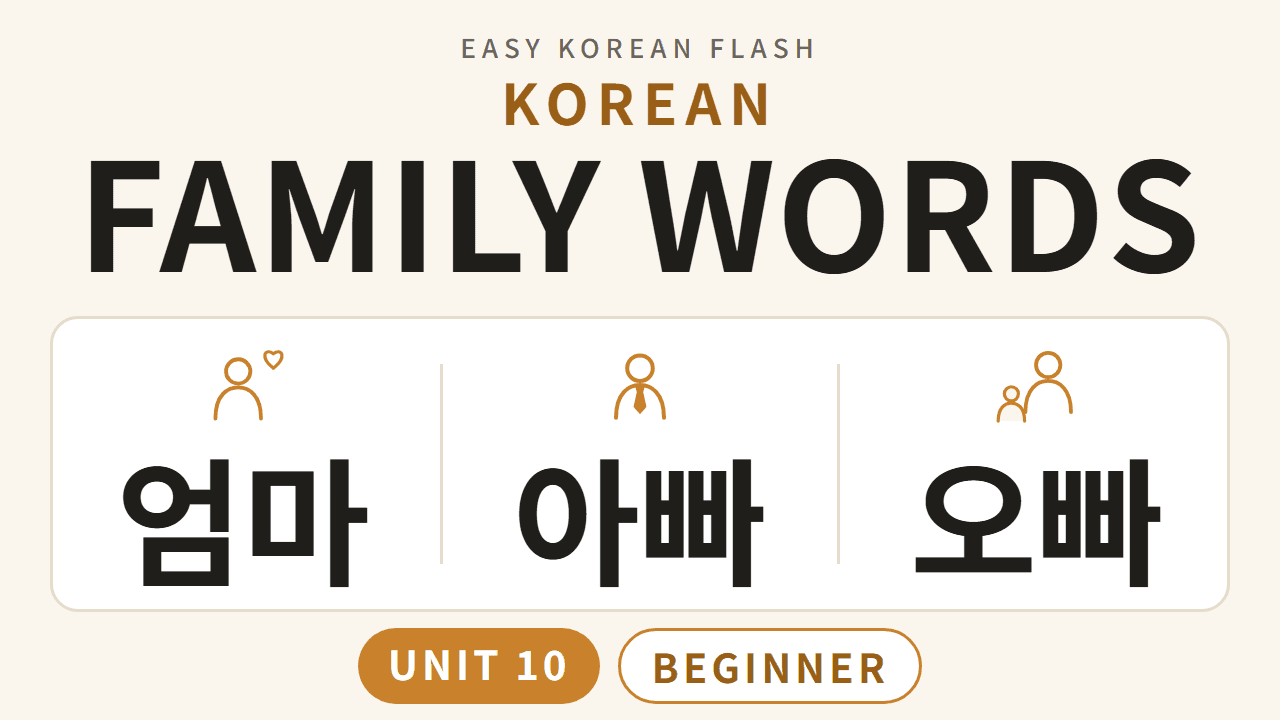
By the end of this lesson you will: read and understand 16 people and family words, and know why Korean has four different words for "older brother" and "older sister".
You finished Hangul in Unit 9. Today the words start to mean something. The method is the same: read first, meaning second.
Try this one. Read it before you scroll:
가족
Two blocks: 가 · 족. Together: gajok. It means family. Now let's meet everyone in it.
🎧 This post goes with the Unit 10 video. Listen to the Korean audio there and repeat after the narrator.
Mission 1: My family
| Word | Say it | Meaning | |
|---|---|---|---|
| 👨👩👧 | 가족 | gajok | family |
| 👩 | 엄마 | eomma | mom |
| 👨 | 아빠 | appa | dad |
| 👩 | 어머니 | eomeoni | mother |
| 👨 | 아버지 | abeoji | father |
| 👪 | 부모님 | bumonim | parents |
Everyday vs. more formal
- 엄마 · 아빠 are warm and everyday. Koreans of all ages say them, even adults.
- 어머니 · 아버지 sound more formal or respectful. You'll hear both pairs in real life.
- 부모님 = 부모 + 님. The ending 님 adds respect. For now, just learn 부모님 as one word for "parents".
Mission 2: Grandparents
| Word | Blocks | Meaning | |
|---|---|---|---|
| 👵 | 할머니 | 할 · 머 · 니 | grandmother |
| 👴 | 할아버지 [하라버지] | 할 · 아 · 버 · 지 | grandfather |
Notice 할아버지. The first block has a bottom letter (ㄹ), and the next block starts with a silent ㅇ. That's the LINK rule from Unit 7: the bottom letter hops over, so it sounds like 하라버지.
Memory hint: 할머니 and 어머니 end the same way (머니). It's just a hint, not a rule for building words.
Mission 3: Who's speaking?
This is the puzzle everyone asks about. In English, "brother" is just "brother". In Korean, an older brother or sister has a different name depending on who is talking.
| If you are a man | If you are a woman | |
|---|---|---|
| Older brother | 형 | 오빠 |
| Older sister | 누나 | 언니 |
Some Korean family words depend on who is speaking.
"Some" matters here. 엄마, 할머니 and 동생 stay the same no matter who says them. Only the older-sibling words change.
These words are also used for close friends who are a bit older than you, with the same speaker rule. That's why you hear 오빠 and 언니 in so many Korean dramas.
Mission 4: Younger, friends, and "I"
| Word | Say it | Meaning | |
|---|---|---|---|
| 🧒 | 동생 | dongsaeng | younger sibling |
| 🤝 | 친구 | chingu | friend |
| 🧑 | 사람 | saram | person (from Unit 6) |
Two ways to say "I"
- 나 is casual. Use it with a close friend.
- 저 is polite. Use it when you meet someone new or talk to someone older.
Both mean "I", but the feeling is different. If you're not sure how casual to be, 저 is often the safer choice.
Mission 5: Family tree
Say each word out loud before you check. Imagine a family tree with you in the middle:
- Above you: 할머니 · 할아버지, then 엄마 · 아빠
- Next to you: 오빠 (a woman speaking) or 형 (a man speaking), 언니 or 누나, 동생
- On the side: 친구
You just named a whole family in Korean!
Review the 16 words
Tap a card to flip it.
← → Arrow keys to navigate · Space to flip
Quick quiz
- Which word means "mom"? A. 엄마 B. 아빠 C. 언니
- You are a woman. What do you call your older brother? A. 형 B. 오빠 C. 누나
- Which word is the polite "I"? A. 나 B. 친구 C. 저
Answers
- A · 엄마
- B · 오빠 (형 is for a man speaking)
- C · 저 (나 is casual)
Want more? Try the quiz on all 16 words:
Quiz Yourself
Choose a mode to test your 16 words
The video also has a Boss Level: you hear a word first, with no text, and pick its meaning. Try it again tomorrow. New words take a few listens to stick.
The real test: four new words
These four words were not in the video. Break each block into letters, then read the word: 아들 · 딸 · 남편 · 아내
Check your work
- 아들 = (ㅇ+ㅏ)(ㄷ+ㅡ+ㄹ) → son
- 딸 = (ㄸ+ㅏ+ㄹ) → daughter (ㄸ is a double consonant from Unit 5)
- 남편 = (ㄴ+ㅏ+ㅁ)(ㅍ+ㅕ+ㄴ) → husband
- 아내 = (ㅇ+ㅏ)(ㄴ+ㅐ) → wife
What to remember
- Read first, meaning second. You can already read every word here.
- 엄마 · 아빠 are everyday. 어머니 · 아버지 are more formal.
- 형 · 누나 are for a man speaking. 오빠 · 언니 are for a woman speaking.
- 나 is casual "I". 저 is polite "I".
- 할아버지 sounds like 하라버지. It's the LINK rule again.
Practice
Read these out loud, with no English:
가족 · 엄마 · 아빠 · 어머니 · 아버지 · 부모님
할머니 · 할아버지 · 형 · 오빠 · 누나 · 언니 · 동생 · 친구 · 나 · 저
Then fill in the word:
- You are a man. Your older brother = ?
- You are a woman. Your older sister = ?
- Talking to a new teacher, "I" = 나 or 저?
Answers
- 형
- 언니
- 저
Next up: Unit 11, numbers. Korean has two sets of numbers, and each one has its own job. It's easier than it sounds.
Free Workbook
Practice what you learned
Printable PDF for “Unit 10: Korean Family Words, 엄마, 아빠, 오빠, 형 Explained” — no sign-up needed.
Unit 10 of Korean From Zero · See all lessons →